
Word Family II

程华明

目录

  • 1 Starter 开篇
    • 1.1 A    How to use a unit
    • 1.2 B    How to learn new words
    • 1.3 C    Abbreviations and symbols
  • 2 Learning 学习
    • 2.1 1  I can talk about vocabulary learning
    • 2.2 2  I can describe my progress and aims
    • 2.3 3  I can understand a learner’s dictionary
    • 2.4 4  I can talk about English punctuation
    • 2.5 Review
  • 3 People 人
    • 3.1 5  I can talk about appearance
    • 3.2 6  I can talk about character
    • 3.3 7  I can describe my feelings
    • 3.4 8  I can talk about relationships
    • 3.5 9  I can talk about families
    • 3.6 10  I can talk about weddings and funerals
    • 3.7 Review
  • 4 The world around us 周围的世界
    • 4.1 11  I can describe the universe
    • 4.2 12  I can talk about rivers and the sea
    • 4.3 13  I can describe the climate
    • 4.4 14  I can describe natural disasters
    • 4.5 15  I can describe animals and insects
    • 4.6 Review
  • 5 Daily life 日常生活
    • 5.1 16  I can describe a range of food
    • 5.2 17  I can talk about diets and cooking
    • 5.3 18  I can talk about money
    • 5.4 19  I can talk about sleep
    • 5.5 20  I can talk about injuries
    • 5.6 21  I can talk about cars and driving
    • 5.7 22  I can describe travel problems and accidents
    • 5.8 23  I can talk about clothes and fashion
    • 5.9 Review
  • 6 Getting things done 完成每一件事
    • 6.1 24  I can describe a visit to the dentist
    • 6.2 25  I can describe hospital procedures
    • 6.3 26  I can explain household tasks
    • 6.4 27  I can describe housework
    • 6.5 28  I can talk to a hairdresser
    • 6.6 Review
  • 7 Describing things 描述事物
    • 7.1 29  I can describe urban life
    • 7.2 30  I can describe parts of a building
    • 7.3 31  I can describe objects
    • 7.4 32  I can describe the senses
    • 7.5 33  I can describe a painting
    • 7.6 34  I can describe actions
    • 7.7 Review
  • 8 Social and political  issues 社会与政治话题
    • 8.1 35  I can talk about crime
    • 8.2 36  I can describe the justice system
    • 8.3 37  I can discuss health issues
    • 8.4 38  I can talk about politics
    • 8.5 39  I can talk about war and peace
    • 8.6 40  I can talk about events in history
    • 8.7 Review
  • 9 Media and entertainment 媒体与娱乐
    • 9.1 41  I can understand newspapers
    • 9.2 42  I can talk about films
    • 9.3 43  I can talk about art and photography
    • 9.4 44  I can talk about music
    • 9.5 45  I can talk about people and places in sport
    • 9.6 46  I can describe sporting events
    • 9.7 47  I can talk about books
    • 9.8 48  I can describe festivals
    • 9.9 Review
  • 10 Work and study 工作与学习
    • 10.1 49  I can get through exams
    • 10.2 50  I can describe university life
    • 10.3 51  I can apply for a job
    • 10.4 52  I can describe jobs
    • 10.5 53  I can describe a career
    • 10.6 54  I can describe working conditions
    • 10.7 Review
  • 11 Business 商务
    • 11.1 55  I can talk about finance
    • 11.2 56  I can talk about companies
    • 11.3 57  I can describe a successful business
    • 11.4 58  I can discuss marketing
    • 11.5 Review
  • 12 Social English 社交英语
    • 12.1 59  I can express probability
    • 12.2 60  I can explain similarities and differences
    • 12.3 61  I can make arrangements to meet
    • 12.4 62  I can discuss my likes and dislikes
    • 12.5 63  I can give my opinion
    • 12.6 64  I can talk about rules
    • 12.7 65  I can discuss hopes and plans
    • 12.8 66  I can express dissatisfaction
    • 12.9 67  I can understand warnings
    • 12.10 Review
  • 13 Language 语言
    • 13.1 68  I can use link words
    • 13.2 69  I can use a range of adjectives
    • 13.3 70  I can express place and time
    • 13.4 71  I can use prepositions in phrases
    • 13.5 72  I can use prefixes
    • 13.6 73  I can use suffixes
    • 13.7 74  I can use verb patterns
    • 13.8 75  I can use phrasal verbs
    • 13.9 76  I can use a range of adverbs
    • 13.10 Review
  • 14 Styles of English 英语文体
    • 14.1 77  I can recognize informal English
    • 14.2 78  I can write a formal letter
    • 14.3 79  I can understand abbreviations and short forms
    • 14.4 80  I can understand American English
    • 14.5 Review
  • 15 Vocabulary building 构词表
  • 16 Spotlight boxes 词汇要点
  • 17 Word list 单词表
33  I can describe a painting

33    I can describe a painting

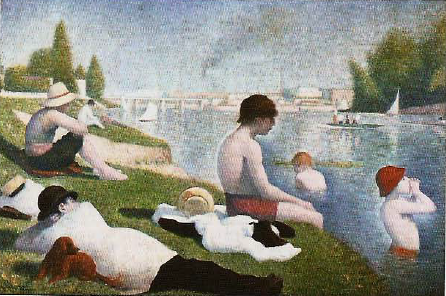
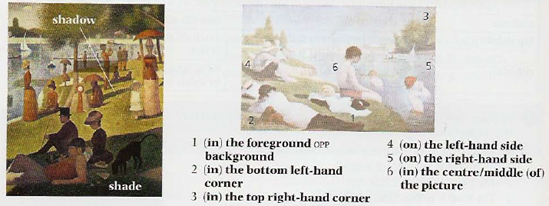
This painting, Bathers at Asnieres by Georges Seurat, illustrates a typical scene of 19th-century leisure and the developing industry in this suburb of Paris. In the foregrounda group of workmen are relaxing by the river; in the distance you can just see the factory where they probably work. Everyone is looking out at the river and ignoring each other, even the little dog in the bottom left-hand corner2. We can sense the warmth of the summer’s day in the bright sunlight, light colours, and shadows.


spotlight  painting and drawing

Bathers at Asnieres is a painting.

Seurat was a painter or artist (artist is a more general word).

paint V.

drawing is a picture made with a pencil or pen, but not paint, draw V.

I paint a lot of portraits.

I can’t draw faces very well.


Glossary

illustrate sth  explain sth in a picture or diagram. illustration N.

scene  a view you can see in a picture or from the place where you are.

leisure  time when you do not have to work.

industry  the production of goods in factories. industrial ADJ.

in the distance  far away from you.

just  If you can just see sth, you can only see it with difficulty.   

ignore sb/sth  pay no attention to sb/sth.  

even  used for emphasizing sth that is surprising.   

sense sth  get a feeling about sth that you can’t directly see or hear.  

warmth  a pleasant heat. 

bright  having a lot of light. OPP dark, brightness N. 


1     Look at the big picture. Write your answers to the questions.

►   Where is the man in the red swimming costume sitting? In the middle of the picture.

1     How many people are there in the foreground? ________

2     Are the boats in the foreground or the background?  ________

3     Are the men sitting in the shade? ________

4     Is the dog in the bottom left-hand corner? ________

5     Can you see the dog’s shadow? ________

6     Is the picture a drawing or a painting? ________

7     Where are the factories? ________

8     On which side of the picture is the boy in the river? ________

9     Are the colours dark or bright? ________

10   On which side is the man wearing the light-coloured hat? ________


1     five

2     the background

3     no

4     yes

5     yes

6     a painting

7     in the distance/background

8     on the right-hand side

9     bright

10   on the left-hand side


3     Put the words in order. Use contractions, e.g. it’s, they’re.

►   dog / foreground / the / in / is / the  The dog’s in the foreground.

1     the / it / you / see / in / can / distance  ________

2     bottom / the / corner / he / is / in / lying / left-hand  ________

3     of / right-hand / is / on / the / it / side / the/ painting?  ________

4     they / the / centre / drawing / of / are / in / sitting / the  ________      

5     in / left-hand / some / there / corner / are / trees / top / the ________


1     You can see it in the distance.

2     He’s lying in the bottom left-hand corner.

3     Is it on the right-hand side of the painting?

4     They’re sitting in the centre of the drawing.;

5     There're some trees in the top left-hand corner.


5     ABOUT YOU Think about a painting you know and like. Write your answers, or ask another student.

1     What’s the name of the artist who painted it? ________

2     Do you know when it was painted? ________         

3     What does the painting illustrate? ________

4     What do you like about the painting? ________

5     Do you do any painting or drawing yourself? If so, what do you do? ________


Answers from a Polish person

1     Gabriela Trykler.

2     Yes, in 1995.

3     It’s an abstract painting.

4     I like the many different ways I can interpret it, depending on my mood. I also like the colours.

5     No, I don’t.