
Word Family II

程华明

目录

  • 1 Starter 开篇
    • 1.1 A    How to use a unit
    • 1.2 B    How to learn new words
    • 1.3 C    Abbreviations and symbols
  • 2 Learning 学习
    • 2.1 1  I can talk about vocabulary learning
    • 2.2 2  I can describe my progress and aims
    • 2.3 3  I can understand a learner’s dictionary
    • 2.4 4  I can talk about English punctuation
    • 2.5 Review
  • 3 People 人
    • 3.1 5  I can talk about appearance
    • 3.2 6  I can talk about character
    • 3.3 7  I can describe my feelings
    • 3.4 8  I can talk about relationships
    • 3.5 9  I can talk about families
    • 3.6 10  I can talk about weddings and funerals
    • 3.7 Review
  • 4 The world around us 周围的世界
    • 4.1 11  I can describe the universe
    • 4.2 12  I can talk about rivers and the sea
    • 4.3 13  I can describe the climate
    • 4.4 14  I can describe natural disasters
    • 4.5 15  I can describe animals and insects
    • 4.6 Review
  • 5 Daily life 日常生活
    • 5.1 16  I can describe a range of food
    • 5.2 17  I can talk about diets and cooking
    • 5.3 18  I can talk about money
    • 5.4 19  I can talk about sleep
    • 5.5 20  I can talk about injuries
    • 5.6 21  I can talk about cars and driving
    • 5.7 22  I can describe travel problems and accidents
    • 5.8 23  I can talk about clothes and fashion
    • 5.9 Review
  • 6 Getting things done 完成每一件事
    • 6.1 24  I can describe a visit to the dentist
    • 6.2 25  I can describe hospital procedures
    • 6.3 26  I can explain household tasks
    • 6.4 27  I can describe housework
    • 6.5 28  I can talk to a hairdresser
    • 6.6 Review
  • 7 Describing things 描述事物
    • 7.1 29  I can describe urban life
    • 7.2 30  I can describe parts of a building
    • 7.3 31  I can describe objects
    • 7.4 32  I can describe the senses
    • 7.5 33  I can describe a painting
    • 7.6 34  I can describe actions
    • 7.7 Review
  • 8 Social and political  issues 社会与政治话题
    • 8.1 35  I can talk about crime
    • 8.2 36  I can describe the justice system
    • 8.3 37  I can discuss health issues
    • 8.4 38  I can talk about politics
    • 8.5 39  I can talk about war and peace
    • 8.6 40  I can talk about events in history
    • 8.7 Review
  • 9 Media and entertainment 媒体与娱乐
    • 9.1 41  I can understand newspapers
    • 9.2 42  I can talk about films
    • 9.3 43  I can talk about art and photography
    • 9.4 44  I can talk about music
    • 9.5 45  I can talk about people and places in sport
    • 9.6 46  I can describe sporting events
    • 9.7 47  I can talk about books
    • 9.8 48  I can describe festivals
    • 9.9 Review
  • 10 Work and study 工作与学习
    • 10.1 49  I can get through exams
    • 10.2 50  I can describe university life
    • 10.3 51  I can apply for a job
    • 10.4 52  I can describe jobs
    • 10.5 53  I can describe a career
    • 10.6 54  I can describe working conditions
    • 10.7 Review
  • 11 Business 商务
    • 11.1 55  I can talk about finance
    • 11.2 56  I can talk about companies
    • 11.3 57  I can describe a successful business
    • 11.4 58  I can discuss marketing
    • 11.5 Review
  • 12 Social English 社交英语
    • 12.1 59  I can express probability
    • 12.2 60  I can explain similarities and differences
    • 12.3 61  I can make arrangements to meet
    • 12.4 62  I can discuss my likes and dislikes
    • 12.5 63  I can give my opinion
    • 12.6 64  I can talk about rules
    • 12.7 65  I can discuss hopes and plans
    • 12.8 66  I can express dissatisfaction
    • 12.9 67  I can understand warnings
    • 12.10 Review
  • 13 Language 语言
    • 13.1 68  I can use link words
    • 13.2 69  I can use a range of adjectives
    • 13.3 70  I can express place and time
    • 13.4 71  I can use prepositions in phrases
    • 13.5 72  I can use prefixes
    • 13.6 73  I can use suffixes
    • 13.7 74  I can use verb patterns
    • 13.8 75  I can use phrasal verbs
    • 13.9 76  I can use a range of adverbs
    • 13.10 Review
  • 14 Styles of English 英语文体
    • 14.1 77  I can recognize informal English
    • 14.2 78  I can write a formal letter
    • 14.3 79  I can understand abbreviations and short forms
    • 14.4 80  I can understand American English
    • 14.5 Review
  • 15 Vocabulary building 构词表
  • 16 Spotlight boxes 词汇要点
  • 17 Word list 单词表
17  I can talk about diets and cooking

17   I can talk about diets and cooking

A    Diets 

Who needs to diet?

I never go on a diet: it’s a waste of time.

Diets list all the food that is good for you, but few people can keep them up. I haven’t put on weight in twenty years. Here’s why:

• I eat almost anything I like, but I don’t eat a lot. And I don’t eat junk food.

I drink plenty of water. It’s better for you than fizzy drinks, and cheaper too.

• I avoid snacks between meals because most of them are fattening.

• I’ve cut down on the amount of food I eat in the evening.

• I get plenty of exercise.


Glossary

a waste of time  a bad use of your time (also a waste of money).

good for you  SYN healthy. OPP bad for you / unhealthy.

keep sth up  continue doing sth.

put on weight  become heavier and fatter. OPP lose weight.

junk food  food which is not good for you (e.g. crisps).

plenty of sth  as much of sth as you need.

fizzy drink  a drink containing small bubbles of gas.

snack  a small amount of food usually eaten between meals.

fattening  making you fatter.

cut down on sth  have less of sth.

exercise  physical activity that keeps you healthy.


spotlight  diet

Aperson’s diet is the food they eat.It can be a balanced diet (all the right food the body needs), or a bad diet (too much of the wrong food). Some people diet / go on a diet,which means eating less to lose weight. 


4     ABOUT YOU  Do you agree with the sentences in Exercise 3? Write Yes or No.


B    Cooking

Recipe for Cottage Pie
 

Ingredients

300 g minced1 beef

300 g potatoes

1 large onion

1 carrot

2-3 chopped tomatoes

300 ml beef stock

1 tablespoon of flour2, butter, salt, and pepper


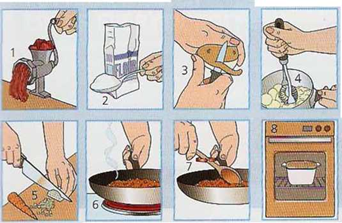
Peel3 the potatoes and boil until just cooked. Then mash4 them with butter. Chop5 the onion and carrot. Fry6 the meat and vegetables quickly, then stirin the flour and cook for one minute. Add the stock, tomatoes, salt and pepper, and let it all cook slowly for 20 minutes. Then put it in a large dish, cover with the mashed potato and some butter, and bake in a hot ovenfor 30 minutes.


Glossary

recipe  a set of instructions for cooking sth.

ingredients  the food items you need to have to make sth to eat.

stock  water with added flavour of meat, fish, or vegetables.

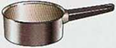
boil sth  cook sth in water, usually in a saucepan.
fry sth  cook sth in oil, usually in a frying pan.

add sth  put sth together with sth else.

dish  a container for serving food at the table (it is larger than a plate).

bake sth  cook sth in the oven without oil or fat (with oil or fat = roast). 


7     Test yourself. Cover the text and say what you can see in the pictures. Then look at the food but cover the cooking instructions. How do you make Cottage Pie?