
Word Family II

程华明

目录

  • 1 Starter 开篇
    • 1.1 A    How to use a unit
    • 1.2 B    How to learn new words
    • 1.3 C    Abbreviations and symbols
  • 2 Learning 学习
    • 2.1 1  I can talk about vocabulary learning
    • 2.2 2  I can describe my progress and aims
    • 2.3 3  I can understand a learner’s dictionary
    • 2.4 4  I can talk about English punctuation
    • 2.5 Review
  • 3 People 人
    • 3.1 5  I can talk about appearance
    • 3.2 6  I can talk about character
    • 3.3 7  I can describe my feelings
    • 3.4 8  I can talk about relationships
    • 3.5 9  I can talk about families
    • 3.6 10  I can talk about weddings and funerals
    • 3.7 Review
  • 4 The world around us 周围的世界
    • 4.1 11  I can describe the universe
    • 4.2 12  I can talk about rivers and the sea
    • 4.3 13  I can describe the climate
    • 4.4 14  I can describe natural disasters
    • 4.5 15  I can describe animals and insects
    • 4.6 Review
  • 5 Daily life 日常生活
    • 5.1 16  I can describe a range of food
    • 5.2 17  I can talk about diets and cooking
    • 5.3 18  I can talk about money
    • 5.4 19  I can talk about sleep
    • 5.5 20  I can talk about injuries
    • 5.6 21  I can talk about cars and driving
    • 5.7 22  I can describe travel problems and accidents
    • 5.8 23  I can talk about clothes and fashion
    • 5.9 Review
  • 6 Getting things done 完成每一件事
    • 6.1 24  I can describe a visit to the dentist
    • 6.2 25  I can describe hospital procedures
    • 6.3 26  I can explain household tasks
    • 6.4 27  I can describe housework
    • 6.5 28  I can talk to a hairdresser
    • 6.6 Review
  • 7 Describing things 描述事物
    • 7.1 29  I can describe urban life
    • 7.2 30  I can describe parts of a building
    • 7.3 31  I can describe objects
    • 7.4 32  I can describe the senses
    • 7.5 33  I can describe a painting
    • 7.6 34  I can describe actions
    • 7.7 Review
  • 8 Social and political  issues 社会与政治话题
    • 8.1 35  I can talk about crime
    • 8.2 36  I can describe the justice system
    • 8.3 37  I can discuss health issues
    • 8.4 38  I can talk about politics
    • 8.5 39  I can talk about war and peace
    • 8.6 40  I can talk about events in history
    • 8.7 Review
  • 9 Media and entertainment 媒体与娱乐
    • 9.1 41  I can understand newspapers
    • 9.2 42  I can talk about films
    • 9.3 43  I can talk about art and photography
    • 9.4 44  I can talk about music
    • 9.5 45  I can talk about people and places in sport
    • 9.6 46  I can describe sporting events
    • 9.7 47  I can talk about books
    • 9.8 48  I can describe festivals
    • 9.9 Review
  • 10 Work and study 工作与学习
    • 10.1 49  I can get through exams
    • 10.2 50  I can describe university life
    • 10.3 51  I can apply for a job
    • 10.4 52  I can describe jobs
    • 10.5 53  I can describe a career
    • 10.6 54  I can describe working conditions
    • 10.7 Review
  • 11 Business 商务
    • 11.1 55  I can talk about finance
    • 11.2 56  I can talk about companies
    • 11.3 57  I can describe a successful business
    • 11.4 58  I can discuss marketing
    • 11.5 Review
  • 12 Social English 社交英语
    • 12.1 59  I can express probability
    • 12.2 60  I can explain similarities and differences
    • 12.3 61  I can make arrangements to meet
    • 12.4 62  I can discuss my likes and dislikes
    • 12.5 63  I can give my opinion
    • 12.6 64  I can talk about rules
    • 12.7 65  I can discuss hopes and plans
    • 12.8 66  I can express dissatisfaction
    • 12.9 67  I can understand warnings
    • 12.10 Review
  • 13 Language 语言
    • 13.1 68  I can use link words
    • 13.2 69  I can use a range of adjectives
    • 13.3 70  I can express place and time
    • 13.4 71  I can use prepositions in phrases
    • 13.5 72  I can use prefixes
    • 13.6 73  I can use suffixes
    • 13.7 74  I can use verb patterns
    • 13.8 75  I can use phrasal verbs
    • 13.9 76  I can use a range of adverbs
    • 13.10 Review
  • 14 Styles of English 英语文体
    • 14.1 77  I can recognize informal English
    • 14.2 78  I can write a formal letter
    • 14.3 79  I can understand abbreviations and short forms
    • 14.4 80  I can understand American English
    • 14.5 Review
  • 15 Vocabulary building 构词表
  • 16 Spotlight boxes 词汇要点
  • 17 Word list 单词表
16  I can describe a range of food

16   I can describe a range of food

A    Fruit, vegetables, and herbs


4     ABOUT YOUR COUNTRY  Write your answers or ask another student.

Do people eat these things in your country? Yes. / Yes, but not much. / No.

papaya ____ 

coconut ____ 

raspberries  ____ 

passion fruit ____

plums ____ 

basil ____ 

parsley  ____ 

chickpeas ____

asparagus ____ 

artichoke ____ 

sweetcorn ____ 

fennel ____


Answers from a British person

papaya Yes, but not much

coconut Yes, but not much

raspberries Yes

passion fruit Yes, but not much

plums Yes

basil Yes

parsley Yes

chick peas Yes, but not much

asparagus Yes

artichoke Yes, but not much

sweetcorn Yes

fennel Yes, but not much


5     Test yourself. Cover the words and name the things in the pictures.


B    Meat, fish, and seafood food
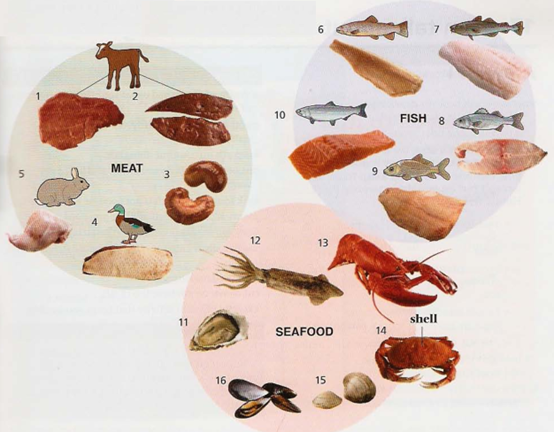

1     veal (meat from a calf, which is a young cow)

2     calf’s liver

3     kidney

4     duck

5     rabbit

6     trout

7     cod

8     sea bass

9     carp

10   salmon

11   oyster

12   squid

13   lobster

14   crab

15   clams

16   mussels

7     ABOUT YOU AND YOUR COUNTRY Write your answers, or ask another student.

1     Which meat do people eat most: veal, rabbit, or duck? ________________

2     Which fish do people eat most: cod, carp, or salmon? ________________

3     Which seafood do people eat most: crab, clams, or mussels? ________________

4     Are there any kinds of seafood above that you never eat? Why? ________________

5     Are there any kinds of meat above that you never eat? Why? ________________

6     Are there any kinds of fish above that you never eat? Why? ________________


Answers from a German person

1     I think most Germans would like to eat a nice piece of veal.

2     I think salmon is the most popular fish in Germany.

3     I don’t eat seafood, but I think it would be crab.

4     I don’t eat any seafood because I don’t like the taste of it very much.

5     I would never eat liver or kidney because don’t like to eat the insides of animals.

6     Out of the five fish, the one I’m least likely to eat is carp. 


8     Test yourself. Look at the pictures and cover the words. Can you name the different types of meat, fish, and seafood?