Word Family II

程华明

目录

  • 1 Starter 开篇
    • 1.1 A    How to use a unit
    • 1.2 B    How to learn new words
    • 1.3 C    Abbreviations and symbols
  • 2 Learning 学习
    • 2.1 1  I can talk about vocabulary learning
    • 2.2 2  I can describe my progress and aims
    • 2.3 3  I can understand a learner’s dictionary
    • 2.4 4  I can talk about English punctuation
    • 2.5 Review
  • 3 People 人
    • 3.1 5  I can talk about appearance
    • 3.2 6  I can talk about character
    • 3.3 7  I can describe my feelings
    • 3.4 8  I can talk about relationships
    • 3.5 9  I can talk about families
    • 3.6 10  I can talk about weddings and funerals
    • 3.7 Review
  • 4 The world around us 周围的世界
    • 4.1 11  I can describe the universe
    • 4.2 12  I can talk about rivers and the sea
    • 4.3 13  I can describe the climate
    • 4.4 14  I can describe natural disasters
    • 4.5 15  I can describe animals and insects
    • 4.6 Review
  • 5 Daily life 日常生活
    • 5.1 16  I can describe a range of food
    • 5.2 17  I can talk about diets and cooking
    • 5.3 18  I can talk about money
    • 5.4 19  I can talk about sleep
    • 5.5 20  I can talk about injuries
    • 5.6 21  I can talk about cars and driving
    • 5.7 22  I can describe travel problems and accidents
    • 5.8 23  I can talk about clothes and fashion
    • 5.9 Review
  • 6 Getting things done 完成每一件事
    • 6.1 24  I can describe a visit to the dentist
    • 6.2 25  I can describe hospital procedures
    • 6.3 26  I can explain household tasks
    • 6.4 27  I can describe housework
    • 6.5 28  I can talk to a hairdresser
    • 6.6 Review
  • 7 Describing things 描述事物
    • 7.1 29  I can describe urban life
    • 7.2 30  I can describe parts of a building
    • 7.3 31  I can describe objects
    • 7.4 32  I can describe the senses
    • 7.5 33  I can describe a painting
    • 7.6 34  I can describe actions
    • 7.7 Review
  • 8 Social and political  issues 社会与政治话题
    • 8.1 35  I can talk about crime
    • 8.2 36  I can describe the justice system
    • 8.3 37  I can discuss health issues
    • 8.4 38  I can talk about politics
    • 8.5 39  I can talk about war and peace
    • 8.6 40  I can talk about events in history
    • 8.7 Review
  • 9 Media and entertainment 媒体与娱乐
    • 9.1 41  I can understand newspapers
    • 9.2 42  I can talk about films
    • 9.3 43  I can talk about art and photography
    • 9.4 44  I can talk about music
    • 9.5 45  I can talk about people and places in sport
    • 9.6 46  I can describe sporting events
    • 9.7 47  I can talk about books
    • 9.8 48  I can describe festivals
    • 9.9 Review
  • 10 Work and study 工作与学习
    • 10.1 49  I can get through exams
    • 10.2 50  I can describe university life
    • 10.3 51  I can apply for a job
    • 10.4 52  I can describe jobs
    • 10.5 53  I can describe a career
    • 10.6 54  I can describe working conditions
    • 10.7 Review
  • 11 Business 商务
    • 11.1 55  I can talk about finance
    • 11.2 56  I can talk about companies
    • 11.3 57  I can describe a successful business
    • 11.4 58  I can discuss marketing
    • 11.5 Review
  • 12 Social English 社交英语
    • 12.1 59  I can express probability
    • 12.2 60  I can explain similarities and differences
    • 12.3 61  I can make arrangements to meet
    • 12.4 62  I can discuss my likes and dislikes
    • 12.5 63  I can give my opinion
    • 12.6 64  I can talk about rules
    • 12.7 65  I can discuss hopes and plans
    • 12.8 66  I can express dissatisfaction
    • 12.9 67  I can understand warnings
    • 12.10 Review
  • 13 Language 语言
    • 13.1 68  I can use link words
    • 13.2 69  I can use a range of adjectives
    • 13.3 70  I can express place and time
    • 13.4 71  I can use prepositions in phrases
    • 13.5 72  I can use prefixes
    • 13.6 73  I can use suffixes
    • 13.7 74  I can use verb patterns
    • 13.8 75  I can use phrasal verbs
    • 13.9 76  I can use a range of adverbs
    • 13.10 Review
  • 14 Styles of English 英语文体
    • 14.1 77  I can recognize informal English
    • 14.2 78  I can write a formal letter
    • 14.3 79  I can understand abbreviations and short forms
    • 14.4 80  I can understand American English
    • 14.5 Review
  • 15 Vocabulary building 构词表
  • 16 Spotlight boxes 词汇要点
  • 17 Word list 单词表
15  I can describe animals and insects

15   I can describe animals and insects

A    Creatures great and small: wild animals and insects
 

Glossary

creature a living thing such as an animal, bird, fish, or insect.

wild living in natural conditions: not looked after by people.

insect  a small animal with six legs, one or two pairs of wings, and a body in three parts. 


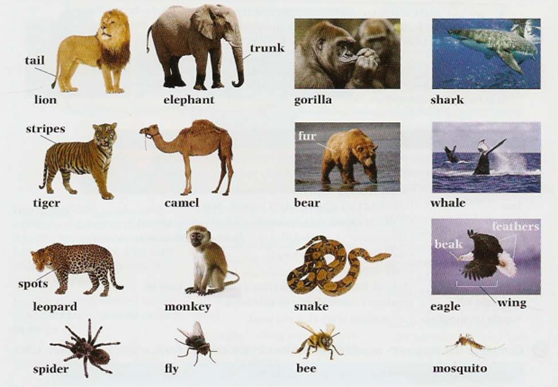
2     Which creature:

►   has wings? fly, eagle, bee, mosquito

1     has a tail? l____, e____, l____, t____, c____, m____

2     is an insect? f____, b____, m____

3     has thick fur? g____, b____

4     has a trunk? e____

5     has stripes? t ____     

6     has spots? l____

7     has a beak and feathers? e____


1     leopard, elephant, lion, tiger, camel, monkey 

2     fly, bee, mosquito;

3     gorilla, bear

4     elephant 

5     tiger 

6     leopard 

7     eagle

B    Unusual facts about animals

Snakes

There are about 2,600 different kinds of snake. About 400 are poisonous, but more are harmless. In size, they vary enormously: the smallest are 12 centimetres long, the biggest are up to 10 metres and weigh 250 kilos. Snakes don’t need energy from food (the sun heats their bodies), so they can survive for months without eating.

Sharks

The average lifespan of a shark is about 25 years but some can live to be 100. They are unusual in that they have no bones in their body, and large sharks may have up to 4,000 teeth. They are very dangerous when they hunt, but only a few attack humans: more people die from bee stings than from shark attacks.


Glossary

poisonous producing a dangerous substance (poison) that can kill or harm you.

harmless not causing damage, injury, or illness. OPP harmful. harm N, V.

vary (of a group) be different from each other.

up to  used when saying the most an amount can be.

weigh have a certain weight N, which is how heavy sth is.

survive continue to live in a difficult situation, survival N.

average normal or typical.

lifespan the time that sth is likely to live (for people, we say life expectancy).

bone

hunt sth  go after sth to catch and kill it.

attack sb/sth  try to hurt sb/sth by using physical force. attack N.

sting a sudden pain caused by poison sent into the skin. sting V. 


C    Farm and small animals
 

spotlight  cows and cattle 

cow is the female animal that is kept on farms to produce milk. The male is a bull. Cows and bulls kept as farm animals can be called cattle. A group of cows is called a herd.


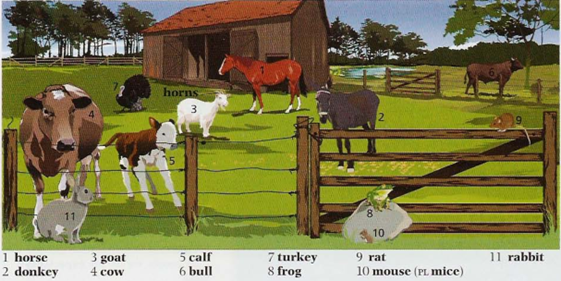
9     ABOUT YOU AND YOUR COUNTRY Answer the questions or ask another student.

1     Which of the animals on this page do people eat? ________________

2     Do people keep these animals in your country? If so, why?

horses? ________________

goats? ________________

bulls? ________________

donkeys? ________________

mice? ________________


Answers from an Italian person

1     In Italy, people eat horse, calf, turkey, donkey, cow, and frog.

2     People keep horses for sport and hobbies.

People keep goats for their milk.

Not many people keep bulls.

Donkeys are often kept in zoos.

People use mice for animal testing. 


10   Test yourself. Look at the picture and cover the words. Say the words.