Word Family II

程华明

目录

  • 1 Starter 开篇
    • 1.1 A    How to use a unit
    • 1.2 B    How to learn new words
    • 1.3 C    Abbreviations and symbols
  • 2 Learning 学习
    • 2.1 1  I can talk about vocabulary learning
    • 2.2 2  I can describe my progress and aims
    • 2.3 3  I can understand a learner’s dictionary
    • 2.4 4  I can talk about English punctuation
    • 2.5 Review
  • 3 People 人
    • 3.1 5  I can talk about appearance
    • 3.2 6  I can talk about character
    • 3.3 7  I can describe my feelings
    • 3.4 8  I can talk about relationships
    • 3.5 9  I can talk about families
    • 3.6 10  I can talk about weddings and funerals
    • 3.7 Review
  • 4 The world around us 周围的世界
    • 4.1 11  I can describe the universe
    • 4.2 12  I can talk about rivers and the sea
    • 4.3 13  I can describe the climate
    • 4.4 14  I can describe natural disasters
    • 4.5 15  I can describe animals and insects
    • 4.6 Review
  • 5 Daily life 日常生活
    • 5.1 16  I can describe a range of food
    • 5.2 17  I can talk about diets and cooking
    • 5.3 18  I can talk about money
    • 5.4 19  I can talk about sleep
    • 5.5 20  I can talk about injuries
    • 5.6 21  I can talk about cars and driving
    • 5.7 22  I can describe travel problems and accidents
    • 5.8 23  I can talk about clothes and fashion
    • 5.9 Review
  • 6 Getting things done 完成每一件事
    • 6.1 24  I can describe a visit to the dentist
    • 6.2 25  I can describe hospital procedures
    • 6.3 26  I can explain household tasks
    • 6.4 27  I can describe housework
    • 6.5 28  I can talk to a hairdresser
    • 6.6 Review
  • 7 Describing things 描述事物
    • 7.1 29  I can describe urban life
    • 7.2 30  I can describe parts of a building
    • 7.3 31  I can describe objects
    • 7.4 32  I can describe the senses
    • 7.5 33  I can describe a painting
    • 7.6 34  I can describe actions
    • 7.7 Review
  • 8 Social and political  issues 社会与政治话题
    • 8.1 35  I can talk about crime
    • 8.2 36  I can describe the justice system
    • 8.3 37  I can discuss health issues
    • 8.4 38  I can talk about politics
    • 8.5 39  I can talk about war and peace
    • 8.6 40  I can talk about events in history
    • 8.7 Review
  • 9 Media and entertainment 媒体与娱乐
    • 9.1 41  I can understand newspapers
    • 9.2 42  I can talk about films
    • 9.3 43  I can talk about art and photography
    • 9.4 44  I can talk about music
    • 9.5 45  I can talk about people and places in sport
    • 9.6 46  I can describe sporting events
    • 9.7 47  I can talk about books
    • 9.8 48  I can describe festivals
    • 9.9 Review
  • 10 Work and study 工作与学习
    • 10.1 49  I can get through exams
    • 10.2 50  I can describe university life
    • 10.3 51  I can apply for a job
    • 10.4 52  I can describe jobs
    • 10.5 53  I can describe a career
    • 10.6 54  I can describe working conditions
    • 10.7 Review
  • 11 Business 商务
    • 11.1 55  I can talk about finance
    • 11.2 56  I can talk about companies
    • 11.3 57  I can describe a successful business
    • 11.4 58  I can discuss marketing
    • 11.5 Review
  • 12 Social English 社交英语
    • 12.1 59  I can express probability
    • 12.2 60  I can explain similarities and differences
    • 12.3 61  I can make arrangements to meet
    • 12.4 62  I can discuss my likes and dislikes
    • 12.5 63  I can give my opinion
    • 12.6 64  I can talk about rules
    • 12.7 65  I can discuss hopes and plans
    • 12.8 66  I can express dissatisfaction
    • 12.9 67  I can understand warnings
    • 12.10 Review
  • 13 Language 语言
    • 13.1 68  I can use link words
    • 13.2 69  I can use a range of adjectives
    • 13.3 70  I can express place and time
    • 13.4 71  I can use prepositions in phrases
    • 13.5 72  I can use prefixes
    • 13.6 73  I can use suffixes
    • 13.7 74  I can use verb patterns
    • 13.8 75  I can use phrasal verbs
    • 13.9 76  I can use a range of adverbs
    • 13.10 Review
  • 14 Styles of English 英语文体
    • 14.1 77  I can recognize informal English
    • 14.2 78  I can write a formal letter
    • 14.3 79  I can understand abbreviations and short forms
    • 14.4 80  I can understand American English
    • 14.5 Review
  • 15 Vocabulary building 构词表
  • 16 Spotlight boxes 词汇要点
  • 17 Word list 单词表
12  I can talk about rivers and the sea

12   I can talk about rivers and the sea

A    Water

RIVERS

wide river                                       narrow river
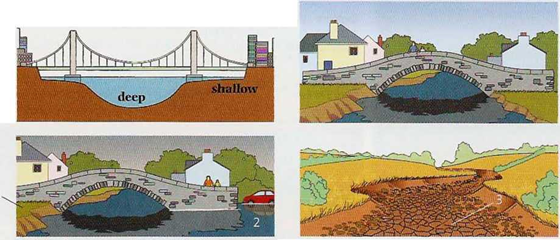
Rivers flow to the sea. A river can be wide (width n) and deep (depth n) or narrow and shallow. If it rains heavily, a river can burst its banks1, which causes floods2. If there is no rain for a long time, the river dries up3.


THE SEA and OCEANS

The tide comes in (high tide) and goes out (low tide) twice a day.

Boats float4 on the surface5 of the water.
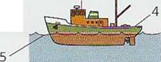


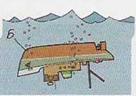
In bad weather, a boat can capsize and sink6. People on the boat may be trapped underwater and may drown.


DIFFERENT AREAS OF WATER


Glossary

flow  move smoothly (like water).

burst  break open suddenly and violently.

ocean  a very big sea, e.g. the Atlantic Ocean.

tide  the regular change in the sea level caused by the moon and sun.

capsize  (used of boats) turn over in the water.

underwater  happening or existing below the surface of the water.

drown  die in water because you can’t breathe.


spotlight  cause V, N

To cause something is to make something (often unpleasant) happen.

The wind caused problems for cyclists.

The cause of something is the person or thing that makes it happen.

The police don’t know the cause of the accident. 


5     Complete the texts with a suitable word in the correct form.

We had some storms with very heavy rain last summer. The river which runs through the city (1) ____ its banks, and (2)   ____ serious floods. The water was quite (3) ____: it was two metres in some parts, and you could see people’s possessions (4) ____ in the water.

We had a terrible day sailing on a (5) ____ in the mountains last weekend. The wind was very strong, and suddenly our little boat (6) ____ and we ended up in the water. We swam to safety, but watched the boat slowly (7) ____ to the bottom. Later we discovered it was very dangerous there, and last year someone (8) ____.

1     burst 

2     caused

3     deep 

4     floating

5     lake 

6     capsized 

7     sink 

8     drowned


B    The coast
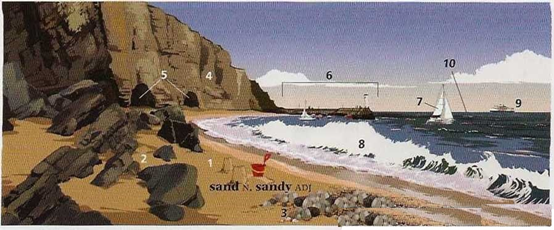

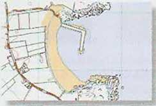
Our local beach1 is mainly sandy, with a few rocks2 and pebblesdown by the shore. There’s a steep cliff4 rising above the beach, and children often play in the caves5 there. At the end of the bay there’s a small harbour6.

When the weather’s bad, the sailing boats7 are protected from the waves8 and the rough sea. We often see large ships9on the horizon10.


Glossary

coast  the area of land that is close to or next to the sea or an ocean.

shore  the land along the edge of the sea, a lake, etc.

steep  A steep hill or cliff goes up quickly from a low place to a high one.

protect sb/sth from sth keep sb/sth safe from sth. protection N.

rough  A rough sea has big waves. OPP calm.


8     Test yourself. Cover the text and look at the picture. What are the words?