Word Family II

程华明

目录

  • 1 Starter 开篇
    • 1.1 A    How to use a unit
    • 1.2 B    How to learn new words
    • 1.3 C    Abbreviations and symbols
  • 2 Learning 学习
    • 2.1 1  I can talk about vocabulary learning
    • 2.2 2  I can describe my progress and aims
    • 2.3 3  I can understand a learner’s dictionary
    • 2.4 4  I can talk about English punctuation
    • 2.5 Review
  • 3 People 人
    • 3.1 5  I can talk about appearance
    • 3.2 6  I can talk about character
    • 3.3 7  I can describe my feelings
    • 3.4 8  I can talk about relationships
    • 3.5 9  I can talk about families
    • 3.6 10  I can talk about weddings and funerals
    • 3.7 Review
  • 4 The world around us 周围的世界
    • 4.1 11  I can describe the universe
    • 4.2 12  I can talk about rivers and the sea
    • 4.3 13  I can describe the climate
    • 4.4 14  I can describe natural disasters
    • 4.5 15  I can describe animals and insects
    • 4.6 Review
  • 5 Daily life 日常生活
    • 5.1 16  I can describe a range of food
    • 5.2 17  I can talk about diets and cooking
    • 5.3 18  I can talk about money
    • 5.4 19  I can talk about sleep
    • 5.5 20  I can talk about injuries
    • 5.6 21  I can talk about cars and driving
    • 5.7 22  I can describe travel problems and accidents
    • 5.8 23  I can talk about clothes and fashion
    • 5.9 Review
  • 6 Getting things done 完成每一件事
    • 6.1 24  I can describe a visit to the dentist
    • 6.2 25  I can describe hospital procedures
    • 6.3 26  I can explain household tasks
    • 6.4 27  I can describe housework
    • 6.5 28  I can talk to a hairdresser
    • 6.6 Review
  • 7 Describing things 描述事物
    • 7.1 29  I can describe urban life
    • 7.2 30  I can describe parts of a building
    • 7.3 31  I can describe objects
    • 7.4 32  I can describe the senses
    • 7.5 33  I can describe a painting
    • 7.6 34  I can describe actions
    • 7.7 Review
  • 8 Social and political  issues 社会与政治话题
    • 8.1 35  I can talk about crime
    • 8.2 36  I can describe the justice system
    • 8.3 37  I can discuss health issues
    • 8.4 38  I can talk about politics
    • 8.5 39  I can talk about war and peace
    • 8.6 40  I can talk about events in history
    • 8.7 Review
  • 9 Media and entertainment 媒体与娱乐
    • 9.1 41  I can understand newspapers
    • 9.2 42  I can talk about films
    • 9.3 43  I can talk about art and photography
    • 9.4 44  I can talk about music
    • 9.5 45  I can talk about people and places in sport
    • 9.6 46  I can describe sporting events
    • 9.7 47  I can talk about books
    • 9.8 48  I can describe festivals
    • 9.9 Review
  • 10 Work and study 工作与学习
    • 10.1 49  I can get through exams
    • 10.2 50  I can describe university life
    • 10.3 51  I can apply for a job
    • 10.4 52  I can describe jobs
    • 10.5 53  I can describe a career
    • 10.6 54  I can describe working conditions
    • 10.7 Review
  • 11 Business 商务
    • 11.1 55  I can talk about finance
    • 11.2 56  I can talk about companies
    • 11.3 57  I can describe a successful business
    • 11.4 58  I can discuss marketing
    • 11.5 Review
  • 12 Social English 社交英语
    • 12.1 59  I can express probability
    • 12.2 60  I can explain similarities and differences
    • 12.3 61  I can make arrangements to meet
    • 12.4 62  I can discuss my likes and dislikes
    • 12.5 63  I can give my opinion
    • 12.6 64  I can talk about rules
    • 12.7 65  I can discuss hopes and plans
    • 12.8 66  I can express dissatisfaction
    • 12.9 67  I can understand warnings
    • 12.10 Review
  • 13 Language 语言
    • 13.1 68  I can use link words
    • 13.2 69  I can use a range of adjectives
    • 13.3 70  I can express place and time
    • 13.4 71  I can use prepositions in phrases
    • 13.5 72  I can use prefixes
    • 13.6 73  I can use suffixes
    • 13.7 74  I can use verb patterns
    • 13.8 75  I can use phrasal verbs
    • 13.9 76  I can use a range of adverbs
    • 13.10 Review
  • 14 Styles of English 英语文体
    • 14.1 77  I can recognize informal English
    • 14.2 78  I can write a formal letter
    • 14.3 79  I can understand abbreviations and short forms
    • 14.4 80  I can understand American English
    • 14.5 Review
  • 15 Vocabulary building 构词表
  • 16 Spotlight boxes 词汇要点
  • 17 Word list 单词表
10  I can talk about weddings and funerals

10   I can talk about weddings and funerals

A    A typical British wedding
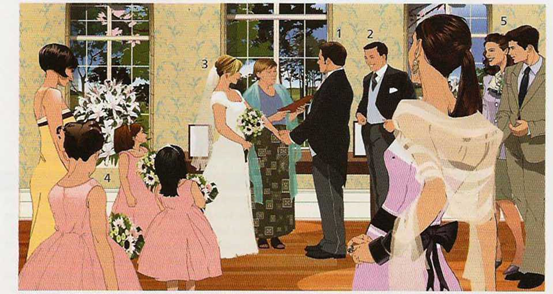
 

When two people are planning to get married, they can choose to have a religious ceremony or a civil ceremony. On the wedding day, the groom1 is helped by a best man2 who brings the rings to the wedding ceremony. The bride3 may have one or more bridesmaids4. Afterwards, there is a reception for the couple and the wedding guests5. It’s traditional for the best man and the groom to make speeches, and then everyone drinks a toast to the couple, and wishes them a long and happy marriage. After the reception, they usually go on their honeymoon. On the same day every year after that, the couple celebrate their wedding anniversary.


Glossary

choose sth PT chose PP chosen  decide which thing you want. choice N.

ceremony  a formal public event.

religious  A religious ceremony takes place in a church, mosque, temple, etc. religion N.

civil  A civil ceremony is a non-religious one.

wedding  a time when a man and woman get married.

rings 

wedding reception   a meal and/or party after a wedding.

traditional  A traditional thing is sth that people have done for a long time.

make a speech  give a formal talk to a lot of people at a special event.

drink a toast to sb  raise a glass of wine, etc. to wish sb success or happiness.

wish sb sth  say that you hope good things will happen to sb.

honeymoon  a holiday for a couple who have just got married.

celebrate sth  have a special meal, party, etc. to show you are happy about sth.

anniversary  the date on which sth happened the previous year or in the past.


spotlight  wedding and marriage; bride and groom

wedding is the ceremony for a couple (two people who are getting married). Marriage is the relationship between a husband and wife.

We went to my sister’s wedding on Saturday.

Jack and Dana’s marriage lasted 40 years.

On the wedding day, the couple are called the bride and groom. After they are married, they become husband and wife


3     Complete the phrases using words below.

►   groom  ceremony  a speech  man  a toast  ceremony  reception   your honeymoon  anniversary  a happy marriage

►   wedding ceremony

1     go on ____

2     drink ____

3     wish someone ____

4     make ____

5     bride and ____

6     celebrate your ____

7     a religious ____

8     the best  ____

9     a wedding ____


1     go on your honeymoon 

2     drink a toast 

3     wish someone a happy marriage 

4     make a speech 

5     bride and groom

6     celebrate your anniversary

7     a religious ceremony

8     the best man 

9     a wedding reception


5     ABOUT YOUR COUNTRY  Answer the questions in Exercise 4, or ask another student.

Answers from a Norwegian person

1     Yes, you can choose either.

2     Yes, he does, and the bride has a best woman.

3     Sometimes younger family members act as bridesmaids.

4     Yes, they do.

5     Yes. The wedding traditionally takes place in the late afternoon, and there’s often a sit-down meal after that.

6     It could be any number.

7     Yes, very much so. The best man, best woman, bridegroom, bride’s father, and sometimes the bride all make speeches. After that, anyone else who wants to speak can do so, and some guests write a song which is performed by all the guests for the couple.

8     Yes, they do.

9     Yes, normally the day after.

10   Yes, they do.  


6     Test yourself. Look at the picture and cover the text. Can you remember the words for the people?


B    The end of a life

graves  2 gravestone  3 mourners; the family are in mourning  4 coffin


Word    Example      Meaning

die (die of an illness) death N, dead ADJ   

He died of old age.

His death was very sad.

stop living.

widow  Mark’s widow never remarried.    

a woman whose husband has died.

widower He’s been a widower for years. 

a man whose wife has died.

funeral  The funeral was at the church.    

a ceremony after sb dies.

bury sb, burialHe was buried this morning.     

put a dead body in the ground.

cremate sb  cremation N  My grandmother wasn’t buried; she was cremated.    

burn the body of a dead person as part of a funeral.

cemetery He’s buried in that cemetery.    

a place where dead people are buried.

willHe left his sister €10,000 in his will.     

a document that says who will have your money or things when you die.

inherit sth  inheritance N  inherited €1,000 from my uncle.   

receive money or things from sb when they die.


10   Test yourself. Cover the words and examples and look at the meanings. Can you remember the words?