
4 I can talk about English punctuation
A Punctuation marks
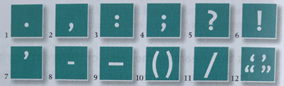
1 full stop
2 comma
3 colon
4 semicolon
5 question mark
6 exclamation mark
7 apostrophe
8 hyphen
9 dash
10 brackets
11 slash
12 quotation marks
2 What punctuation is used 1-8 below? You don’t need to repeat full stop each time.
► We went home early. full stop
1 She had long, blonde hair. ____
2 What are you doing? ____
3 Congratulations! ____
4 It’s too late. ____
5 I looked in the fridge; it was empty. ____
6 Someone (not me) left the door open. ____
7 A five-minute walk - and he still took a taxi . ____ ____
8 ‘It’s only me,’ he said. ____ ____ ____
1 comma
2 question mark
3 exclamation mark
4 apostrophe
5 semicolon
6 brackets
7 hyphen, dash
8 quotation marks, apostrophe, comma
3 Test yourself. Cover the words and look at
the punctuation marks. What are they?
B Punctuation rules
A full stop is used at the end of a sentence that is not a question or an exclamation, and
is sometimes used in abbreviations. Each new sentence must begin with a capital
letter.
A comma in writing is like a pause in speech. It is used:
-
to separate parts of a sentence,
e.g. After we left, someone tried to phone us.
-
between adjectives, e.g. A big, expensive car.
-
to separate words in a list, though
it is often omitted before and. e.g.
I went to France, Germany, Italy and Spain.
-
when words or phrases interrupt the
normal progression of a sentence, e.g. I decided, however, that I needed
something to eat first.
A colon is often used to introduce further details such as an explanation or a list, e.g. The shop is full of
antiques: dining tables, chairs, wardrobes, mirrors, and so on.
A semicolon is sometimes used instead of a full stop when two sentences
are very closely connected, or to
separate two main clauses, especially ones that aren’t joined by a conjunction such as and or but, e.g. I went round this morning; nobody was there.
A slash separates words or phrases that are alternatives, e.g. single/married.
Glossary
abbreviation a short form of a word (e.g. a.m. is an
abbreviation meaning ‘in the morning’).
capital letter A B C are capital letters (a b c are small letters).
pause a short period of time when sb stops talking.
separate sb/sth keep people or things away from each other. SYN divide sb/sth.
list a series of names, items. or numbers (e.g. a shopping list, a list of countries).
omit sth FML If you omit sth. you don’t include it. SYN leave sth out.
interrupt sth occur in the middle of sth and stop it
continuing.
details small pieces of information about sth.
instead of
sb/sth in the place of sb/sth.
connect sth put two or more things together. SYN join sth.
such as You use such as to introduce an example. SYN like.
alternative one of two or more things that you can choose between.
5 Find pairs of words in the box that go
together for a reason. Write a sentence about them.
comma
omit abbreviation join such
as✓ p.m. information separate like✓ leave out full stop details divide connect
► ‘Such as’ and ‘like’ mean the same thing.
________________
________________
________________
________________
________________
________________
‘Comma’
and ‘full stop’ are both punctuation marks.
‘p.m.’
is an abbreviation.
‘Omit’
and ‘leave out’ mean the same thing.
‘Join’
and ‘connect’ mean the same thing.
‘Information’
and ‘details’ mean the same thing.
6 What punctuation is missing, and where?
► We live in this house A full stop is missing at the end of the
sentence.
1 she works in Bristol. ________________
2 He’s a tall thin boy. ________________
3 The book is in on the table. Which is correct? ________________
4 We have two choices stay here and wait, or go and look for them. ________________
5 When we arrived we went straight to a
restaurant. ________________
6 This is my boyfriends watch. ________________
7 After that fortunately we had no more problems. ________________
8 We couldn’t get in the door was locked. ________________
1 ‘She’ needs a capital letter (not a small
letter).
2 A comma is missing after ‘tall’.
3 A slash is missing between ‘in’ and ‘on’.
4 A colon is missing after ‘choices’.
5 A comma is missing after ‘arrived’.
6 An apostrophe is missing after ‘boyfriend’ and before ‘s’.
7 Commas are missing before and after ‘fortunately’.
8 A comma is missing after ‘in’.

