
Chapter 7 Distribution
7.3 Distribution Channels
Distribution is a logistics end delivery service in which goods move from supplier to user within a relatively fixed distance and time span. It includes both the physical movement of goods and handling of related procedures. Distribution focuses on customer satisfaction and aims at cost reduction. Its operation is often centralized and integrated within a specific cover area.
7.3.1 Concepts of Distribution Channels
A channel of distribution can be defined as the collection of organization units, either internal or external to the manufacturer, which performs the functions involved in product marketing. The marketing functions are pervasive; they include buying, selling, transporting, storing, grading, financing, bearing market risk, and providing marketing information. Any organizational unit, institution, or agency that performs one or more of the marketing functions is a member of the channel of distribution.
Distribution channel is determined by marketing functions which are performed by specific organizations. Some channel members perform single marketing functions—carriers transport products, and public warehouses store them. Others, such as wholesalers, perform multiple functions. Channel structure affects a) control over the performance of functions, b) the speed of delivery and communication, and c) the cost of operations. While a direct manufacturer-to-user channel usually gives management greater control over the performance of marketing functions, distribution costs normally are higher, making it necessary for the firm to have substantial sales volume or market concentration. With indirect channels, the external institutions or agencies (warehouses, wholesalers, and retailers) assume much of the cost burden and risk, but the manufacturer receives less revenue per unit.
Most distribution channels are loosely structured networks of vertically aligned firms. The specific structure depends to a large extent on the nature of the product and the firm’s target market. Figure 7.1 illustrates a number of possible channel structures for consumer products. Figure 7.2 depicts alternative channels for industrial products. However, the figures do not show the many forms of middlemen/ intermediaries. Also, they do not include the institutions involved in transportation (carriers) and storage (warehouses), even though these, too, are basic and necessary marketing functions.
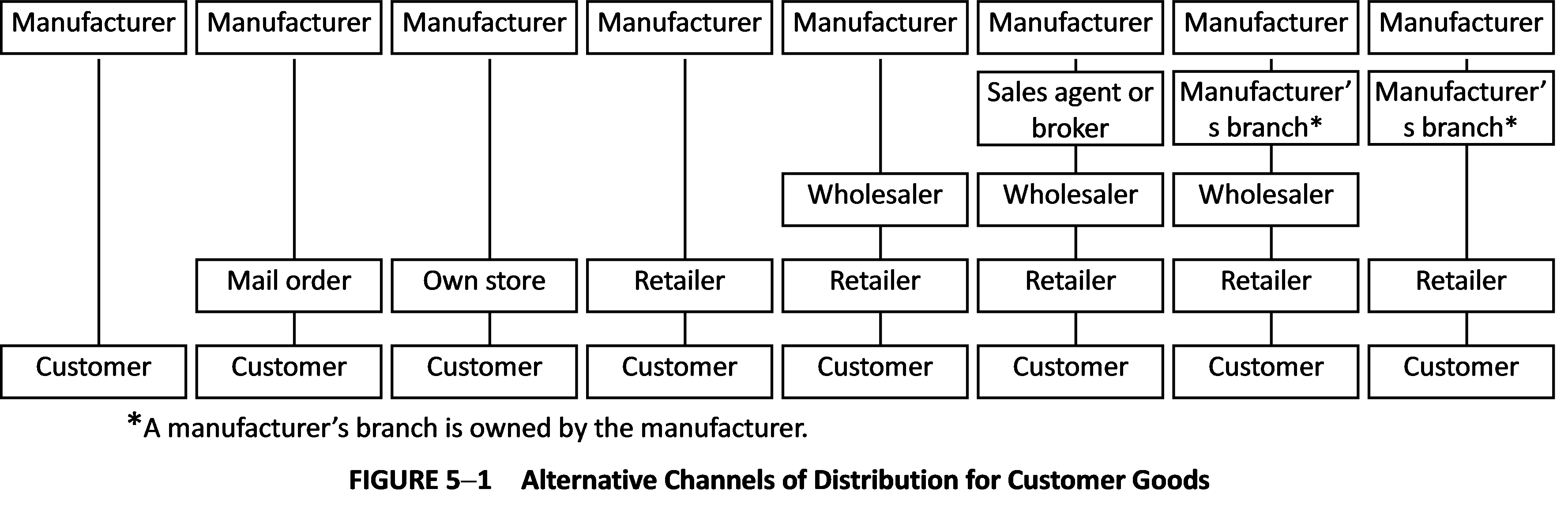
Figure 7.1 Alternative channels of distribution for customer goods
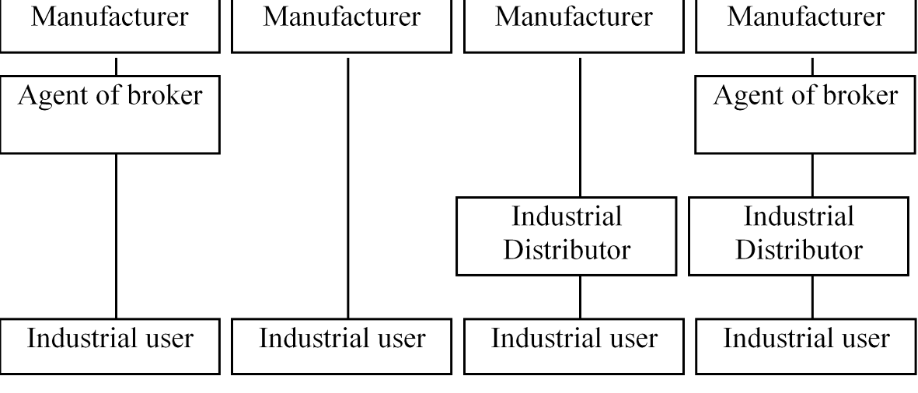
Figure 7.2 Alternative channels of distribution for industrial goods
There is no “best” channel structure for all firms producing similar products. Management must determine channel structure within the framework of the firm’s corporate and marketing objectives, its operating philosophy, its strengths and weaknesses, and its infrastructure of manufacturing facilities and warehouses. If the firm has targeted multiple market segments, management may have to develop multiple channels to service these markets efficiently. For example, Whirlpool Corporation sells a major portion of its product through Sears, uses distributors and dealers for its Whirlpool brand line, and also sells to original equipment manufacturers (OEM accounts).
7.3.2 Significance of Channel Structure
Channel structure was viewed as a function of product life cycle, logistics systems, and effective communication networks. Channel structure was also regarded as a function of product characteristics. A direct relationship between firm size and the type of distribution channel should be employed, with large firms more likely to be vertically integrated. Vertical integration occurs when one member of a channel performs the functions of another member, thus combining one or more of the channel levels through ownership, administered power, or contractual agreements.
The most detailed theory of channel structure was developed by Bucklin. He bases his theory on the economic relationships among distributive institutions and agencies. He stated that the purpose of the channel is to provide consumers with the desired combination of its outputs (lot size, delivery time, and market decentralization) at minimal cost. Consumers determine channel structure by purchasing combinations of service outputs. The best channel has formed when no other group of institutions generates more profits or more consumer satisfaction per dollar of product cost Bucklin concluded that functions will be shifted from one channel member to another in order to achieve the most efficient and effective channel structure. Given a desired level of output by the consumer and competitive conditions, channel institutions will arrange their functional tasks in such a way as to minimize total channel costs. This shifting of specific functions may lead to addition or deletion of channel members.
(1) Postponement and speculation
Channel structure establishment is based on the concepts of postponement and speculation. Its costs can be reduced by a) postponing changes in the form and identity of a product to the last possible point in the marketing process, and b) postponing inventory location to the last possible point in time, since risk and uncertainty costs increase as the product becomes more differentiated. Postponement results in savings because it moves differentiation nearer to the time of purchase, when demand is more easily forecast. This reduces risk and uncertainty costs. Logistics costs are reduced by sorting products in large lots, in relatively undifferentiated states.
Companies can use postponement to shift the risk of owning goods from one channel member to another. That is, a manufacturer may refuse to produce until it receives firm orders; a middleman may postpone owning inventories by purchasing from sellers who offer faster delivery or by purchasing only when a sale has been made; and consumers may postpone ownership by buying from retail outlets where the products are in stock. Perhaps the best example of postponement is the mixing of paint colors at the retail level. Rather than having to forecast the exact colors that consumers will want to purchase, the retailer mixes paint in any color that the consumer wishes to purchase at the time of purchase. Other examples include color panels in the front of built-in kitchen appliances that enable the same unit to be any one of a number of colors; the centralization of slow-selling products in one warehouse location; and the building of slow-moving items only after orders have been received.
Speculation is the converse of postponement: “The principle of speculation holds that changes in form, and the movement of goods to forward inventories, should be made at the earliest possible time in the marketing process in order to reduce the costs of the marketing system” That is, a channel institution assumes risk rather than shifting it. Speculation can reduce marketing costs through a) the economies of large-scale production, b) the placement of large orders, which reduces the costs of order processing and transportation, c) the reduction of stockouts and their associated cost, and d) the reduction of uncertainty. To reduce the need for speculative inventories, many firms are exploring strategies of time-based competition. For example, in 1989, Northern Telecom was able to “manufacture products in about half the time it took just two or three years ago. Inventory and overhead have dropped, and quality has improved. Overall customer satisfaction has steadily risen.”
Postponement and speculation are concepts that allow us to understand channel structures and their evolution. The existence of speculative inventories may result in an indirect channel if the intermediary can perform the inventory risk-taking function at a lower cost than the manufacturer. Freight forwarders and agent middlemen who do not take title may reduce logistics costs in more direct channels of distribution where non-speculative inventories are present.
(2) Functional spin-off within the channel of distribution
Mallen’s concept of functional spin-off within the distribution channel helps the marketer understand channel structure and predict structural change. His framework supports Bucklin’s concepts of postponement and speculation. Mallen’s work has several key hypotheses:
a) A producer will spin off a marketing function to a marketing intermediary if the latter can perform the function more efficiently than the former.
b) If there are continual economies to be obtained within a wide range of volume changes, the middleman portion of the industry (and perhaps individual middlemen) will become bigger and bigger.
c) A producer will keep a marketing function if the producer can perform the function at least as efficiently as the intermediary.
d) If a producer is more efficient in one market, the producer will perform the marketing function; if in another market the middleman is more efficient, then the middleman will perform the function.
e) If there are not economies of scale in a growing market, more firms may be expected to enter the channel.
Additional factors that can influence channel structure include: technological, cultural, physical, social, and political factors; physical factors such as geography, size of market area, location of production centers, and concentration of population; local, state, and federal laws; social and behavioral variables.
(3) Reasons for uneconomic channels
Due to the influence of social, cultural, political, and economic variables, channels may not necessarily be as efficient or effective as they should be, the following reasons were given for the existence of uneconomic channels:
a) Reseller solidarity. Resellers in many lines of trade function as groups that tend to support traditional trade practices and long-established institutional relationships. The presence of a strong professional or trade association tends to reinforce conservative group behavior and inhibit innovation within the channel.
b) Entrepreneurial values. The large reseller, given sufficient time to adjust, tends to be responsive to innovation, but smaller resellers tend to have relatively static expectations.
c) Organizational rigidity. A firm, because of organizational rigidities, prefers to respond incrementally to innovation. It gradually will imitate the innovating firm or develop counterstrategies over an extended period of time. If the innovator has penetrated the firm’s core market, however, it must respond quickly to this challenge in order to ensure continued operation.
d) Channel position of a firm. Firms operating as members of the dominant channel are either unwilling or unable to develop an entirely new method of distribution. Thus, a firm completely outside the system is most likely to introduce basic innovations.
e) Market segmentation. Innovative methods of operation appeal to a limited number of market segments, and conventional institutions are not compelled to change.

