
Chapter 1 Introduction to Logistics
1.4 The Role of Logistics in the Economy and Organizations
1.4.1 Logistics in the Economy- A Macro Perspective
Logistics has become an enormously important component of the gross domestic product (GDP) of industrialized nations and thus affects the rate of inflation, interest rates, productivity, energy costs and its availability and other aspects of the economy as well. Ever changing business environment due to globalization, lead time reductions, customer orientation, and outsourcing has contributed to the interest in logistics. The increase in global production sharing, the shortening of product life cycles, and the increase of global competition all underline logistics as a strategic source of competitive advantage. Moreover, in order to remain in competitive marketplace and earn reasonable profits, organizations interest in logistics has been increased. Logistics operations have become more efficient due to technological advancements which make it possible to deliver goods on time while reducing the cost involved.
As China’s economy grows, so grows its transportation and logistics industry. China is becoming a more mature and self-confident country and a driving force in the new global economic structure and this is bringing new challenges and opportunities to the five sections of the country’s transportation and logistics industry-express, road freight, air freight, contract logistics, and international freight forwarding.
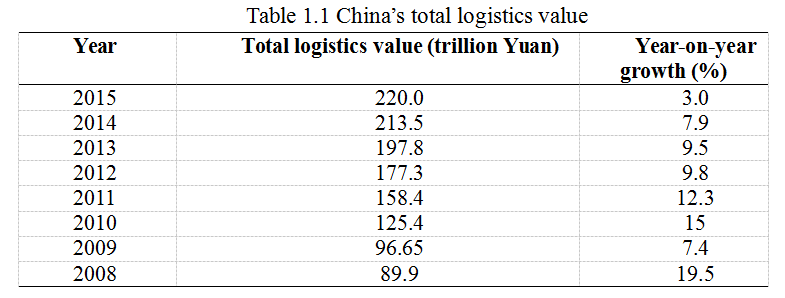
The total value of goods carried by China's logistics industry and year-on-year growth from 2008 to 2015 are presented in Table 1.1. Manufacturing sector remains key to China’s economy. The logistics value of industrial products accounted for a substantial share of the total logistics value.
Efficiency of the logistics industry is reflected by the total logistics cost as a percentage of GDP. The lower the ratio, the more efficient the logistics sector is. In China, the ratio has been decreasing over the past few years (2008: 18.3%, 2009: 18.1%, 2010: 17.8%, 2011: 17.8%, 2012: 18%, 2013: 18%); it stayed at 16.6% in 2014. This ratio is still twice the ratios observed in other developed countries. In the United States and Japan, the ratio of logistics cost to their GDP was around 8 percent in 2013.
1.4.2 Logistics in the Firm-A Micro Perspective
Logistics is critical to the success of every organization. Once considered an important behind-the-scenes operational activity, logistics is now recognized as a strategic tool for creating customer value and loyalty. Companies like Wal-Mart, Coca Cola, and Nike attribute a great deal of their success to their global logistics systems. They realize that integrating activities within the organization and across the logistics pipeline, building strong relationships with product suppliers, and working with customer-focused logistics service providers are all critical to building a competitive advantage through logistics.
1.4.2.1 Logistics Interfaces with Marketing
Logistics in an organization are considered as a continuation of marketing. Logistics play a critical role in each of the three critical elements of the marketing concept (customer satisfaction, integrated effort/systems approach and corporate profit) in several ways (Figure 1.4).
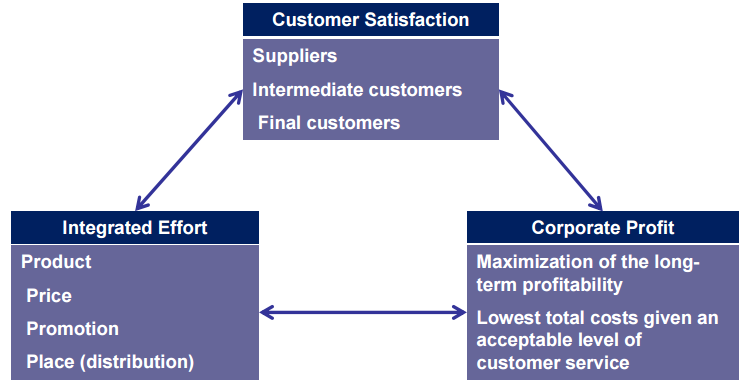
Figure 1.4 Marketing/logistics management concept
Customer satisfaction involves maximizing time and place utility to the firm’s suppliers, intermediate customers, and final customers. Logistics’ ability to provide customer service, coupled with marketing’s skill in generating and completing sales, create an acceptable level of customer satisfaction, which can lead to a differential advantage in the marketplace. Integrated effort requires that the company coordinate its marketing activities (product, price, promotion, and distribution) to achieve synergistic results; the ‘total should be greater than the sum of its parts. The key to true integration is the “total cost concept,” which examines the cost trade-offs that occur between and within the marketing and logistics activities. The final component of the marketing/logistics management concept¾company profit¾recognizes the need to achieve an acceptable level of long-term profits. From a financial perspective, the optimal means of achieving this profitability may be to minimize total logistics costs while providing the level of customer service dictated by the firm’s overall marketing strategy and the expectations of customers.
1.4.2.2 Logistics Adds Utility
Economic utility is the value or usefulness of a product in fulfilling customer needs or wants. The four general types of economic utility are: (1) possession utility, (2) form utility, (3) place utility, and (4) time utility.
Possession utility is the value added to a product by allowing the customer to take ownership of the item. Possession utility is not a result of logistics, but the offering of credit, quantity discounts, and delayed payments which enable the customer to assume possession of the product. The logistics and marketing processes culminate in possession utility.
Form utility refers to a product’s being in a form that can be used by the customer and is of value to the customer. Form utility has generally been associated with production and manufacturing. Manufactured products possess some value or utility because an assembled item is worth more than its unassembled components or raw materials. A Completed automobile, for example, is much more valuable to a consumer than its unassembled parts. The value, or utility, of making materials available in a completed state is called form utility.
Place utility is the value created or added to a product by making it available for purchase or consumption in the right place. Logistics is directly responsible for adding place utility to products as it efficiently moves raw materials, in-process inventory, and finished goods from point-of-origin to point-of-consumption.
Time utility is the value created by making something available at the right time. Products are not as valuable to customers if they are not available precisely when they are needed. For example, a food processing company must have raw materials (food items), packaging materials, and other items available before the production process begins¾or, if already begun, before existing supplies run out. Failure to receive these items at the proper time can cause costly production shutdowns and place the firm in a disadvantageous competitive position.
Management is quite concerned with the “value added” utility by logistics, because improvements in place and time utility are ultimately reflected in the firm’s profits. Cost savings in logistics or a stronger marketing position due to an improved logistics system can both cause improved bottom line performance. In firms where logistics contributes a significant portion of the “value added” to a product, logistics management is particularly important.
1.4.2.3 Logistics adds competitive advantage
Faced with relentless competitive pressures in an increasingly global market place, firms have responded with a variety of business strategies aimed at enhancing customer value. These strategies include, among others, offering a broader product mix to customers to fulfill the product variety needs, global sourcing of parts and components and global distribution to ensure cost effectiveness through economies of scale, and time based competition to enhance responsiveness to customer needs. At Volkswagen’s dealerships in North America and Europe, one popular sales person joke is that “the car has already covered10,000km with no mileage on the clock”. This joke corroborates the vast spread of Volkswagen’s global supply chain; the total distance traversed by components traveling from supplier plants to the company’ s assembly plants in Mexico and the assembled cars being delivered to fulfill customer demand in the built-to-stock North American market and the built-to-order European market approximates reasonably to10,000km.
Logistics management or supply chain management has often been described as the next frontier of competition. Simchi-Levietal (2003) have suggested that in industries such as retailing and computer and printer manufacturing, supply chain management is perhaps the most important factor in determining the success of the firm. The successful implementation of supply chain strategies in technology, apparel, and retail industries by firms like Wal-Mart, Zara, Hewlett-Packard, and Dell Computers has attracted the attention of managers on the Crucial role that logistics management plays in business strategy. Incorporating the full impact of logistics into the firm’s strategy is therefore a crucial imperative for firms and can lead to superior and sustainable performance.
1.4.2.4 Logistics is a Proprietary Asset
A superior logistics system is a proprietary asset that cannot be easily duplicated by the firm’s competitors. If a company can provide its customers with products quickly and at low cost, it can gain market share advantages over its competitors. It might be able to sell its product at a lower cost as a result of logistics efficiencies, or provide a higher level of customer service, thereby creating goodwill. Although no firms presently identify this “asset” in their balance sheets, it theoretically could be shown as an intangible asset, a category that includes such items as patents, copyrights, and trademarks.

