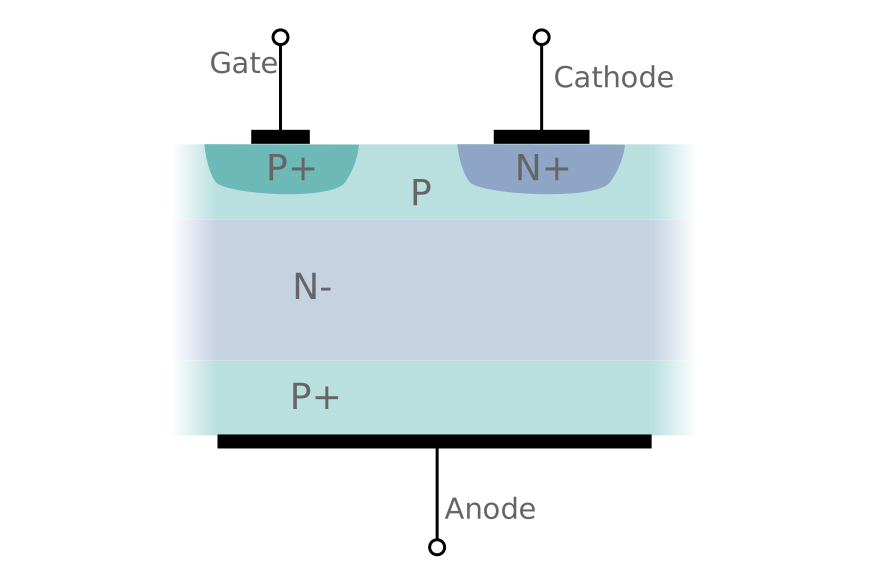
The gate turn-off thyristor is based upon the basic thyristor technology but has the ability to be turned off by the gate action.
The Gate Turn-Off Thyristor, GTO is a variant of the more standard form of thyristor. Rather than the gate being used to turn the thyristor on, within a gate turn-off thyristor, GTO, the gate pulse turns the device off.
The additional capabilities of the gate-turn-gg thyristor enable it to be used in applications where a standard thyristor would not be suitable. Although its use is more limited, it can be used in a number of specialist applications.
These gate turn-off thyristors are useful in a number of areas, particularly within variable speed motor drives, high power, inverters and similar areas. Although they are not nearly as well known as the more standard forms of thyristor, the gate turn off thyristor, is now widely used as it is able to overcome many of the disadvantages of the traditional thyristor. As a result the gate turn-off thyristor is used in virtually all DC to AC and DC to DC high voltage conversion units
The capability for the gate turn off thyristor to be turned-on by a gate signal, and also turned-off by a gate signal of negative polarity give it a unique capability within the thyristor family of devices.
The device turn on is accomplished by a "positive current" pulse between the gate and cathode terminals. As the gate-cathode behaves like PN junction, there is a relatively small voltage between the terminals.
The turn on phenomenon in GTO is however, not as reliable as that of a standard thyristor and small positive gate current must be maintained even after turn on to improve reliability.
Gate turn-off thyristor structure
Like the standard thyristor, the gate turn-off thyristor is a four layer device having three junctions. Again the layers are P N P N with the outside p layer providing the anode connection, and the outside n layer providing he cathode connection.
To attain high emitter efficiency, the cathode layer is highly doped to give an n+ region. This has the drawback that it renders the junction nearest to the cathode (normally referred to as J3) with a low breakdown voltage - typically 20- 40 volts.
The doping level of the p region for the gate is graded. This is to provide good emitter efficiency for which the doping level should be low, while providing a good turn off characteristic for which a high doping level is needed.
The gate electrode is often inter-digitated to optimise the current turn=off capability. High current devices, i.e. 1000A and above may have several thousand segments which are all connected to the common gate contact.
Another key parameter for a gate turn-off thyristor is the maximum forward blocking voltage. This is determined by the doping level and thickness of the n type base region. As many devices may need to block voltages of several kilovolts, the doping level of this region needs to be kept relatively low.