
Java语言

王晓蒙

目录

  • 1 Introduction to Java
    • 1.1 Programming Languages
    • 1.2 Java Introduction
    • 1.3 JDK Installation
    • 1.4 A Simple Program
    • 1.5 Programming Style and Documentation
    • 1.6 Programming Error
    • 1.7 Programming Using Eclipse
    • 1.8 Review Questions
  • 2 Elementary Programming
    • 2.1 Identifiers, Variables and Constants
    • 2.2 Input By Console
    • 2.3 Numeric Data Type and Literals
    • 2.4 Augmented Numeric Operators
    • 2.5 Numeric Type Conversions
    • 2.6 Mathematical Methods
    • 2.7 Character Data Type
    • 2.8 Using String Type
    • 2.9 Console Formatting Output
  • 3 Selections
    • 3.1 Boolean and Relational Operators
    • 3.2 if-else
    • 3.3 Logical Operators
    • 3.4 switch
  • 4 Loops
    • 4.1 while
    • 4.2 Case: Guessing Numbers
    • 4.3 do-while
    • 4.4 for
    • 4.5 Nested Loops
    • 4.6 break and continue
    • 4.7 Case: Checking Palindromes
  • 5 Methods
    • 5.1 Defining and Calling a Method
    • 5.2 Passing Arguments By Values
    • 5.3 Modularizing Code
    • 5.4 Overloading Methods
    • 5.5 Variables Scope
  • 6 Arrays
    • 6.1 Array Basics
    • 6.2 Case: Analyzing Numbers
    • 6.3 Copying Arrays
    • 6.4 Passing Arrays to Methods
    • 6.5 Variable-Length Arguments List
    • 6.6 The Arrays Class
    • 6.7 Two-Dimensional Arrays Basics
    • 6.8 Two-Dimensional Arrays Processing
    • 6.9 Multidimensional Arrays
  • 7 Objects and Classes
    • 7.1 Introduction to OOP
    • 7.2 Defining Classes and Creating Objects
    • 7.3 Constructors
    • 7.4 Reference Variables and Reference Types
    • 7.5 Using Java Library
    • 7.6 Static Members
    • 7.7 Visibility Modifers
    • 7.8 Passing Objects to Methods
    • 7.9 This Keyword
    • 7.10 Wrapper Class
    • 7.11 Immutable and Interned Strings
  • 8 Inheritance and Polymorphism
    • 8.1 Super-classes and Sub-classes
    • 8.2 super Keyword and Constructor Chaining
    • 8.3 Overriding
    • 8.4 Polymorphism
    • 8.5 Objects Casting
    • 8.6 The method equals
    • 8.7 The protected Members
  • 9 Abstract Classes and Interfaces
    • 9.1 Abstract Classes
    • 9.2 Interfaces
    • 9.3 Comparable Interface
  • 10 Exception Handling
    • 10.1 Introduction
    • 10.2 Exception Declaring and Throwing
    • 10.3 Exception Catching and Handling
    • 10.4 finally
  • 11 I/O Operation
    • 11.1 I/O Introduction
    • 11.2 Binary Input
    • 11.3 Binary Output
    • 11.4 Text Input
    • 11.5 Text Output
  • 12 JavaFX Basics
    • 12.1 A Basic JavaFX Program
    • 12.2 Node Types
    • 12.3 Property Binding
    • 12.4 Node Style
    • 12.5 Layout
    • 12.6 JavaFX and Eclipse
  • 13 Event-Driven Programming
    • 13.1 Event-Source, Event and Event-Handler
    • 13.2 Defining Event-Handler Using Inner-Class
    • 13.3 Event Handling Using Lambda Expression
  • 14 Others
Comparable Interface


Comparable Interface

Comparable是Java API中的一个用于比较操作的接口,查找、排序等算法中两个元素的比较必不可少,而且比较操作依赖于数据类型。怎么样使得Java API中的排序算法应用于我们自定义的数据类型呢?这里就需要借助于Comparable,它在排序算法和我们自定义的数据类型之间形成了一个抽象层,实现了算法层次和数据类型比较操作的解耦,我们具体还是以几何图形按面积排序来讲解。

1. 定义一个抽象类ComparableGeometry,让所有的几何形状拥有一致的比较操作:
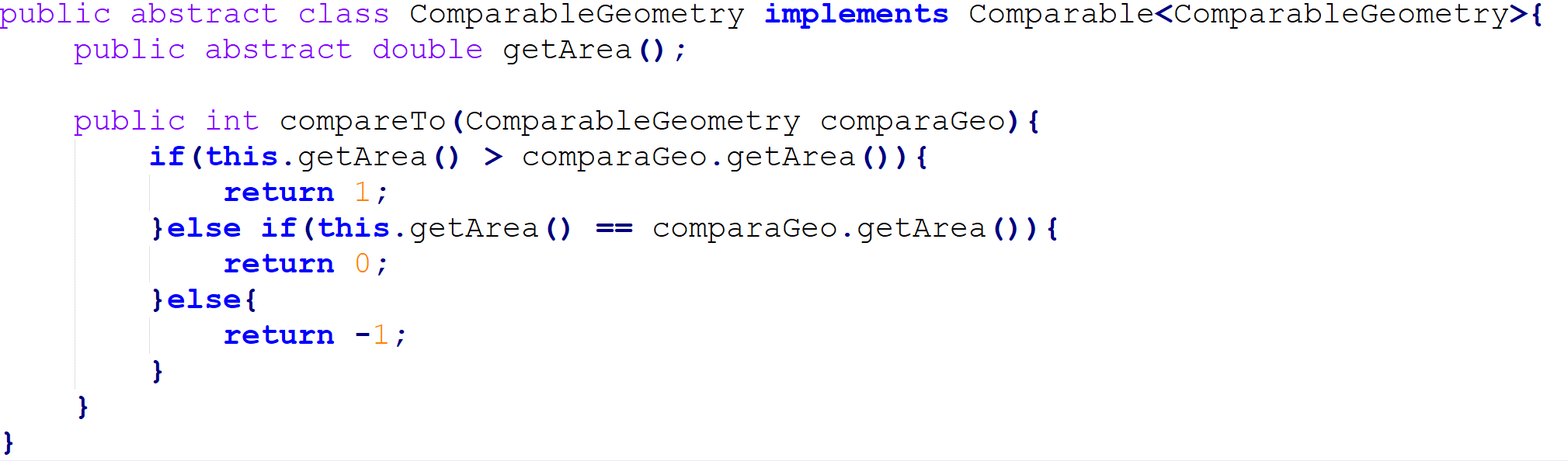
ComparableGeometry实现了Comparable<>接口,<>中的是泛型类型,这里针对几何图形进行比较,所以采用Comparable<ComparableGeometry>。实现接口中的compareTo方法,编写比较操作的业务代码,如果当前对象面积大则返回正数1,相等则返回0,面积较小则返回负数-1。

2. 定义实体类ComparableCircle和ComparableRectangle,其内容和之前的类似。

3. 客户端应用Arrays的public static void sort(Object[] a)函数进行排序,sort函数要求a中的所有对象都实现了comparable接口。
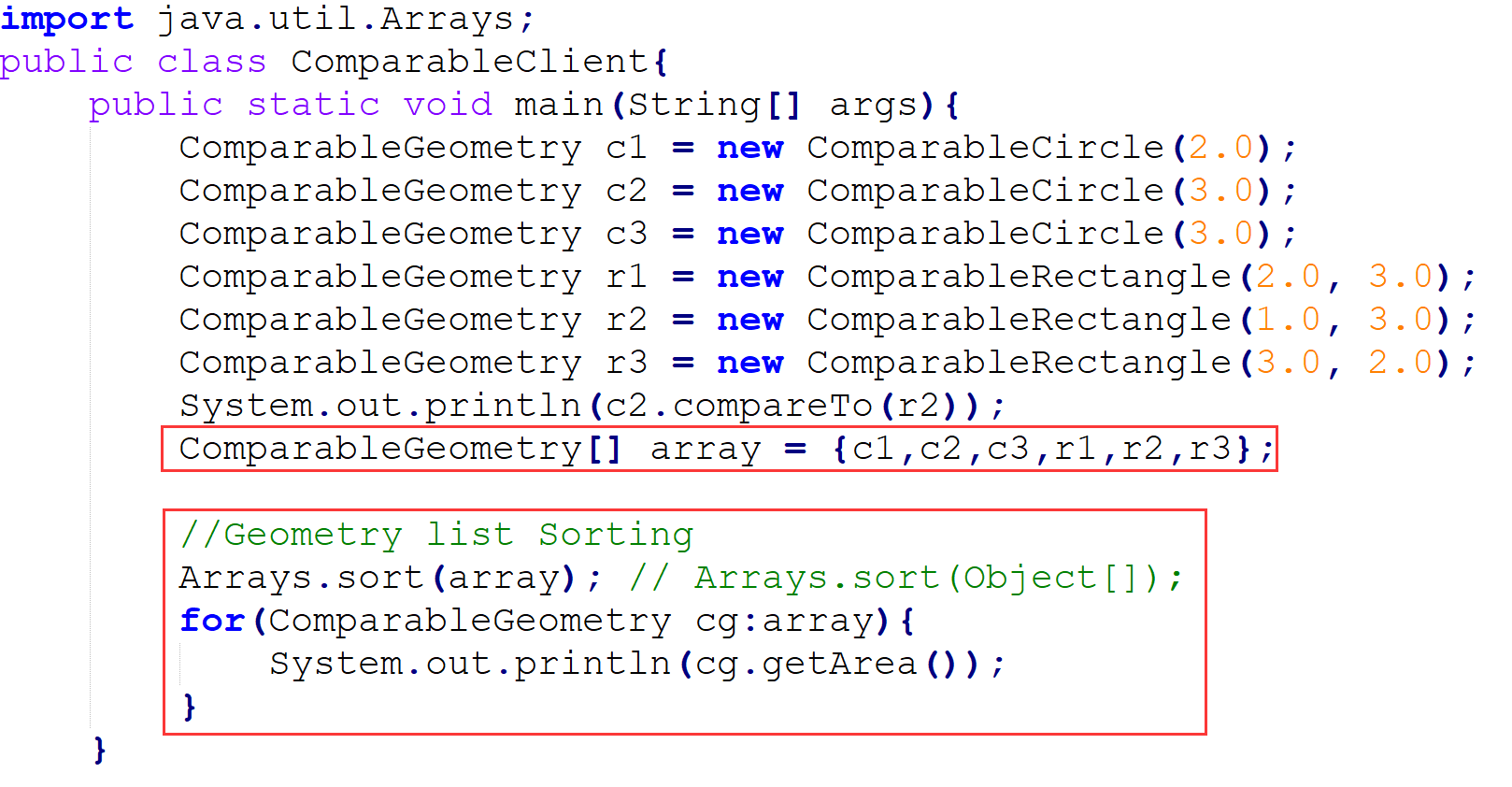
ComparableGeometry数组中既有矩形,也有圆形,进行排序时,不需要自己编写排序算法,直接用Java API提供的就可以了,Java API这种“超预见”的设计就是由面向抽象编程实现的,在以后的应用中,只要不是特殊需要,我们不用编写任何排序算法。