
·ideas
Logic
With the Prior Analytics, Aristotle is credited with the earlieststudy of formal logic, and his conception of it was the dominant form ofWestern logic until 19th century advances in mathematical logic. Kant stated inthe Critique of Pure Reason that Aristotle's theory of logic completelyaccounted for the core of deductive inference.
History
Aristotle "says that 'on the subject of reasoning' he 'hadnothing else on an  earlier date to speak of'". However, Plato reports thatsyntax was devised before him, by Prodicus of Ceos, who was concerned by thecorrect use of words. Logic seems to have emerged from dialectics; the earlierphilosophers made frequent use of concepts like reduction ad absurdum in theirdiscussions, but never truly understood the logical implications. Even Platohad difficulties with logic; although he had a reasonable conception of adeductive system, he could never actually construct one, thus he relied insteadon his dialectic.
Analytics and the Organon
What we today call Aristotelian logic, Aristotle himself wouldhave labeled "analytics". The term "logic" he reserved tomean dialectics. Most of Aristotle's work is probably not in its original form,because it was most likely edited by students and later lecturers. The logicalworks of Aristotle were compiled into six books in about the early 1st centuryCE:
1. Categories
2. On Interpretation
3. Prior Analytics
4. Posterior Analytics
5. Topics
6. On Sophistical Refutations
The order of the books (or the teachings from which they arecomposed) is not certain, but this list was derived from analysis ofAristotle's writings. It goes from the basics, the analysis of simple terms inthe Categories, the analysis of propositions and their elementary relations inOn Interpretation, to the study of more complex forms, namely, syllogisms (inthe Analytics) and dialectics (in the Topics and Sophistical Refutations). Thefirst three treatises form the core of the logical theory stricto sensu: thegrammar of the language of logic and the correct rules of reasoning. There isone volume of Aristotle's concerning logic not found in the Organon, namely thefourth book of Metaphysics.
Aristotle's epistemology
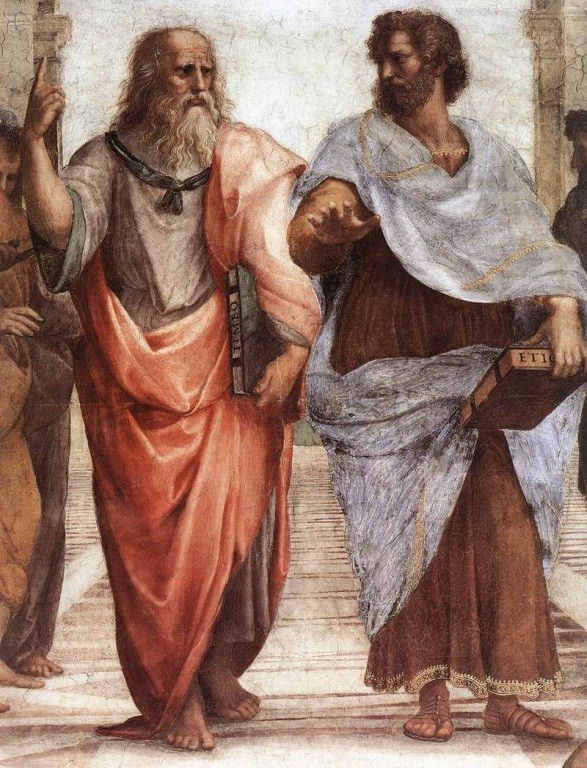
Like his teacher Plato, Aristotle's philosophy aims at theuniversal. Aristotle's ontology, however, finds the universal in particularthings, which he calls the essence of things, while in Plato's ontology, theuniversal exists apart from particular things, and is related to them as theirprototype or exemplar. For Aristotle, therefore, epistemology is based on thestudy of particular phenomena and rises to the knowledge of essences, while forPlato epistemology begins with knowledge of universal Forms (or ideas) anddescends to knowledge of particular imitations of these. For Aristotle,"form" still refers to the unconditional basis of phenomena but is"instantiated" in a particular substance (see Universals andparticulars, below). In a certain sense, Aristotle's method is both inductiveand deductive, while Plato's is essentially deductive from a priori principles.
If logic (or "analytics") is regarded as a studypreliminary to philosophy, the divisions of Aristotelian philosophy wouldconsist of: (1) Logic; (2) Theoretical Philosophy, including Metaphysics,Physics and Mathematics; (3) Practical Philosophy and (4) Poetical Philosophy.
Causality, the four causes
Aristotle suggested that the reason for anything coming aboutcan be attributed to four different types of simultaneously active causalfactors:
1. Material cause describes the material out of which something iscomposed. Thus the material cause of a table is wood, and the material cause ofa car is rubber and steel. It is not about action. It does not mean one dominoknocks over another domino.
2. The formal cause is its form, i.e., the arrangement of thatmatter. It tells us what a thing is, that any thing is determined by thedefinition, form, pattern, essence, whole, synthesis or archetype. It embracesthe account of causes in terms of fundamental principles or general laws, asthe whole (i.e., macrostructure) is the cause of its parts, a relationshipknown as the whole-part causation.
3. The efficient cause is "the primary source", or thatfrom which the change under consideration proceeds. It identifies 'what makesof what is made and what causes change of what is changed' and so suggests allsorts of agents, nonliving or living, acting as the sources of change ormovement or rest.
4. The final cause is its purpose, or that for the sake of which athing exists or is done, including both purposeful and instrumental actions andactivities. The final cause or teleos is the purpose or function that somethingis supposed to serve. This covers modern ideas of motivating causes, such as volition,need, desire, ethics, or spiritual beliefs.
Substance, potentiality and actuality
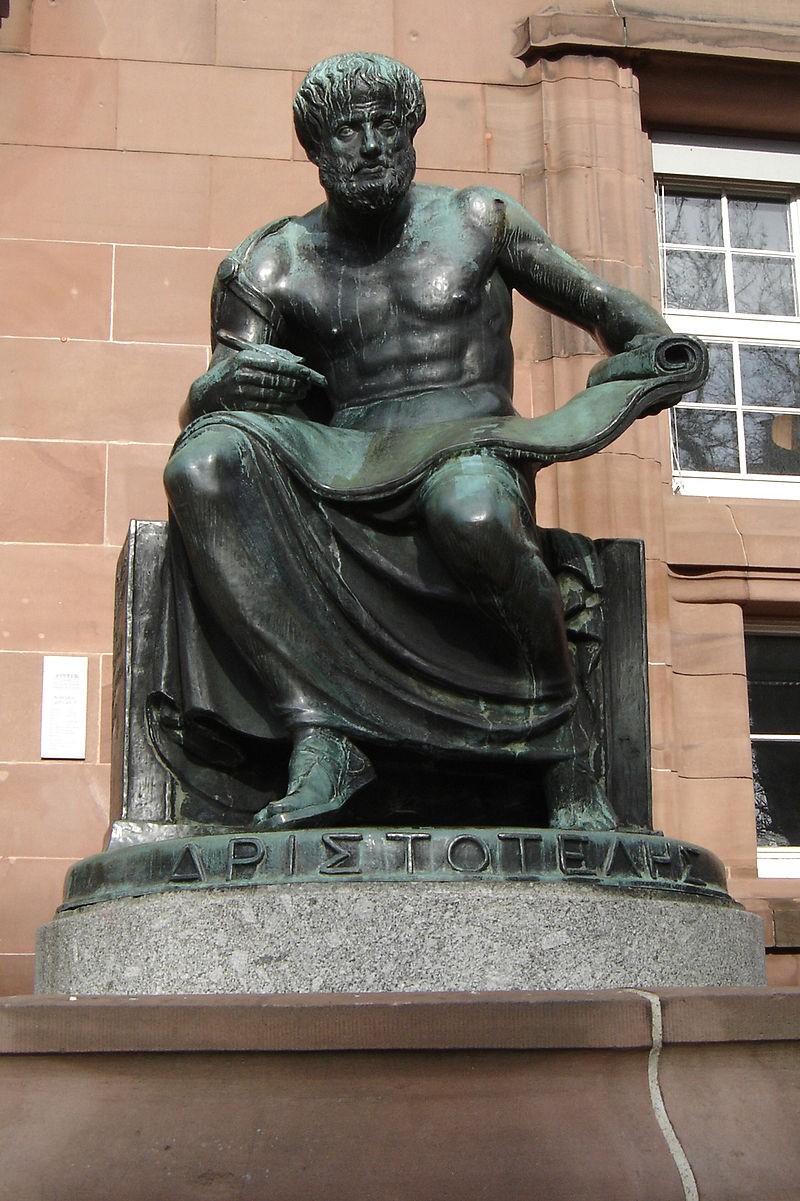 Aristotle examines the concepts of substance and essence (ousia)in his Metaphysics (Book VII), and he concludes that a particular substance isa combination of both matter and form. In book VIII, he distinguishes thematter of the substance as the substratum, or the stuff of which it iscomposed. For example, the matter of a house is the bricks, stones, timbersetc., or whatever constitutes the potential house, while the form of thesubstance is the actual house, namely 'covering for bodies and chattels' or anyother differentia (see also predicables) that let us define something as ahouse. The formula that gives the components is the account of the matter, andthe formula that gives the differentia is the account of the form.
Universals and particulars
Aristotle's predecessor, Plato, argued that all things have auniversal form, which could be either a property, or a relation to otherthings. When we look at an apple, for example, we see an apple, and we can alsoanalyze a form of an apple. In this distinction, there is a particular appleand a universal form of an apple. Moreover, we can place an apple next to abook, so that we can speak of both the book and apple as being next to eachother.
Psychology
Aristotle's psychology, given in his treatise On the Soul (peripsyche, often known by its Latin title De Anima), posits three kinds of soul("psyches"): the vegetative soul, the sensitive soul, and therational soul. Humans have a rational soul. This kind of soul is capable of thesame powers as the other kinds: Like the vegetative soul it can grow andnourish itself; like the sensitive soul it can experience sensations and movelocally. The unique part of the human, rational soul is its ability to receiveforms of other things and compare them.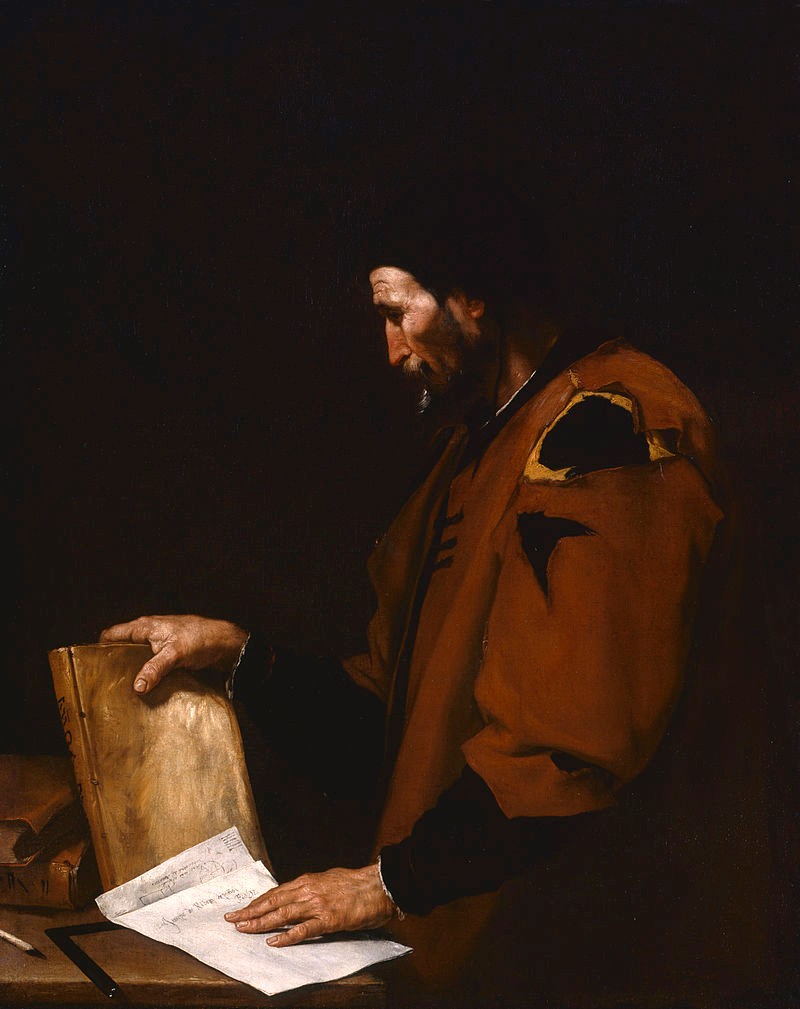
For Aristotle, the soul (psyche) was a simpler concept than itis for us today. By soul he simply meant the form of a living being. Becauseall beings are composites of form and matter, the form of living beings is thatwhich endows them with what is specific to living beings, e.g. the ability toinitiate movement (or in the case of plants, growth and chemicaltransformations, which Aristotle considers types of movement).
Rhetoric and poetics
Aristotle considered epic poetry, tragedy, comedy, dithyrambicpoetry and music 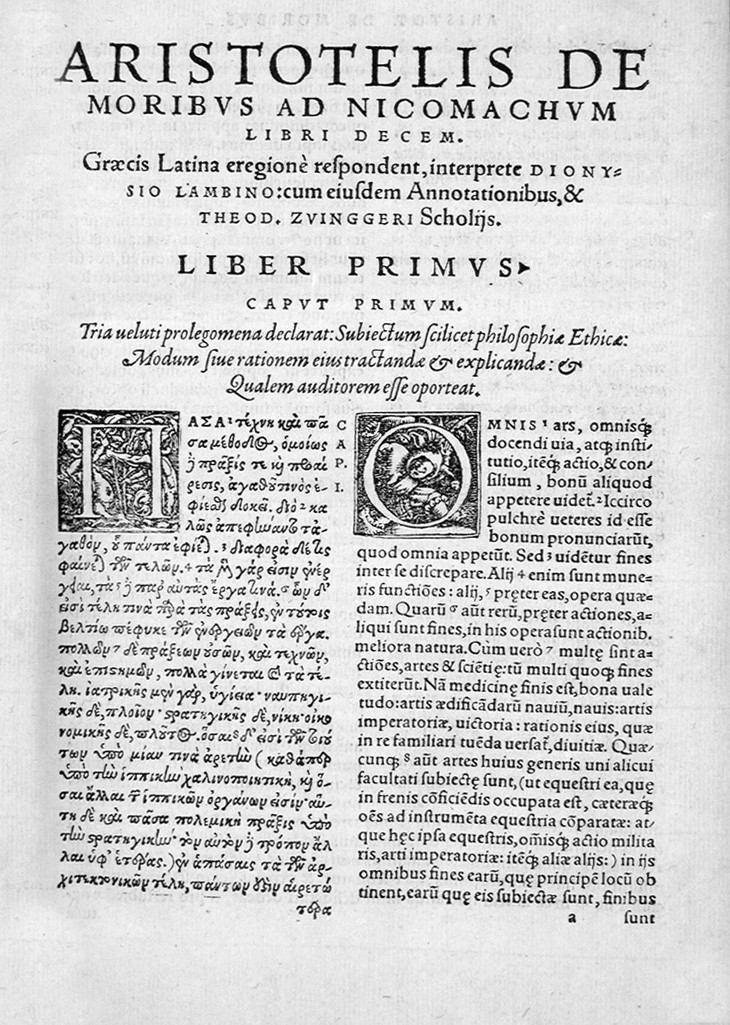 to be imitative, each varying in imitation by medium, object,and manner. For example, music imitates with the media of rhythm and harmony,whereas dance imitates with rhythm alone, and poetry with language. The formsalso differ in their object of imitation. Comedy, for instance, is a dramaticimitation of men worse than average; whereas tragedy imitates men slightlybetter than average. Lastly, the forms differ in their manner of imitation –through narrative or character, through change or no change, and through dramaor no drama. Aristotle believed that imitation is natural to mankind andconstitutes one of mankind's advantages over animals.

